Category: Noticias

  • Series A financing for a ground breaking drug development by a Institut Pasteur of Montevideo

    Series A financing for a ground breaking drug development by a Institut Pasteur of Montevideo

    [fusion_builder_container hundred_percent=”no” equal_height_columns=”no” menu_anchor=”” hide_on_mobile=”small-visibility,medium-visibility,large-visibility” class=”” id=”” background_color=”” background_image=”” background_position=”center center” background_repeat=”no-repeat” fade=”no” background_parallax=”none” parallax_speed=”0.3″ video_mp4=”” video_webm=”” video_ogv=”” video_url=”” video_aspect_ratio=”16:9″ video_loop=”yes” video_mute=”yes” overlay_color=”” video_preview_image=”” border_size=”” border_color=”” border_style=”solid” padding_top=”” padding_bottom=”” padding_left=”” padding_right=””][fusion_builder_row][fusion_builder_column type=”1_1″ layout=”1_1″ background_position=”left top” background_color=”” border_size=”” border_color=”” border_style=”solid” border_position=”all” spacing=”yes” background_image=”” background_repeat=”no-repeat” padding_top=”” padding_right=”” padding_bottom=”” padding_left=”” margin_top=”0px” margin_bottom=”0px” class=”” id=”” animation_type=”” animation_speed=”0.3″ animation_direction=”left” hide_on_mobile=”small-visibility,medium-visibility,large-visibility” center_content=”no” last=”no” min_height=”” hover_type=”none” link=””][fusion_text]

    Eolo Pharma (www.eolo-pharma.com), a pioneering South American biotech company developing multiple drugs that stop low grade chronic inflammation, is pleased to announce that it has successfully closed an oversubscribed Series A financing round of 2.7 million dollars. The proceeds will be used to carry out preclinical and toxicological tests on a new compound for the prevention and treatment of obesity and its metabolic complications. Once these studies are finished, the company will be able to advance to human tests under global FDA standards. “In South America, despite having a critical mass of research in pharmacology, there have been no significant developments of new drugs in the last 50 years,” said Pía Garat, CEO of Eolo Pharma.

    Eolo Pharma is a biotech spin off from the Institut Pasteur de Montevideo that was initiated more than 10 years ago through a collaboration of a multidisciplinary team of scientists of Institut Pasteur de Montevideo and la Universidad de la República, Uruguay. The company is operating out of its operational base in Uruguay with a holding company in the U.S.A. and a subsidiary in Argentina. The company obtained its first seed investment from CITES, the venture capital fund and startup accelerator of the Sancor Seguros Group, together with a joint venture of the Scientific Accelerators program of the Argentine government.

    In the present finance round (Series A), CITES is a repeat investor together with a group of international investors led by Paul Elberse of FICUS CAPITAL (www.ficuscapital.comwww.globalscopepartners.com). The investors were very excited to have a direct opportunity to participate in a high quality biotech company entering into clinical trials in humans, focused on a high potential impact in society with a solution to a pressing global health issue, especially as these opportunities often remain reserved for the professional VC funds.

    “We are honored by the trust of our investors placed in the team. We will use the funds to move towards the clinical development of our leading compound”, said Pía Garat, CEO of Eolo Pharma.

    Eolo Pharma’s technology is protected by invention patents with worldwide coverage that were co-developed between the Institut Pasteur of Montevideo (http://pasteur.uy/en/home/) and the University of the Republic of Uruguay and licensed to the company. In this regard, Carlos Batthyány, director of the Institut Pasteur, commented that “in recent years it has become clear that all developed countries have science, technology and innovation as central strategies for the development of knowledge-based, and sustainable economies. For the researchers of this project it is a great achievement that from Uruguay you can do curiosity driven science and go one step further, trying to take a compound from the lab to the pharmacy. The Institut Pasteur de Montevideo is committed to continue this path by performing more and better science, but with the commitment that in cases that warrant it, knowledge can be turned into an innovative product”.

    Eolo Pharma counts with a sophisticated team of international advisors with a recognized track record in the development of pharmaceuticals with a presence in the United States, Italy, Switzerland and Argentina. He has also participated in multiple international fairs, capturing the interest of pharmaceutical and biotechnology companies that are leaders in the market.

    ————————

    About Eolo Pharma

    Eolo Pharma has as its main focus the development of new drugs for diseases related to chronic inflammation, promoting disruptive therapies for the treatment and prevention of some of the main causes of death in the world. The company has global patents that are the result of the accumulation of more than 15 years of research developed by its founders. Its developments, protected worldwide with intellectual property patents, cover cardiovascular diseases, obesity-induced insulin resistance, neurodegenerative diseases such as Amyotrophic Lateral Sclerosis (ALS), allograft transplantation and autoimmune diseases.

    www.eolo-pharma.com

    About the Institut Pasteur of Montevideo

    The Institut Pasteur de Montevideo (IP Montevideo) is one of the centers that make up the International Network of Pasteur Institutes, which associates 33 independent scientific institutions on five continents and are united by the same culture and values. Dedicated to scientific research in the area of biological medicine applied to human and animal health, the IP Montevideo is formed by research laboratories that rely on scientific technological platforms in areas such as genomics, proteomics and bioinformatics. Its mission is to generate original knowledge and disruptive technological advances and of high international standard. With these examples and proof of concept, the IP Montevideo intends to value research and thus contribute to Uruguay begin to walk the path towards a sustainable economy based on knowledge and innovation with high added value.

    http://pasteur.uy/en/home/

    About FICUS CAPITAL

    FICUS Capital offers a complete array of services in the development of, and investments in large-scale projects, M&A advisory services, corporate finance and direct investments (seed, VC and PE). FICUS Capital designs the capital structures and directly invests in the renewable energy, biotech, technology and agtech sectors. FICUS Capital is characterized by the great commitment with the transactions it selects, working with interdisciplinary teams with varied professional skill sets and reaches more than 46 countries through its partnership in the Globalscope network.

    www.ficuscapital.com

    www.globalscopepartners.com

    About CITES

    CITES is an entrepreneurial capital investor in early stages, which invests, accelerates and incubates projects based on disruptive science that address the needs of global markets. CITES is the only investor in Latin America specialized in finding or generating investment opportunities based on patents within the regional scientific system. This thesis allows you to maximize your returns, and lead the development of scientific-technological entrepreneurship in the region.

    www.cites-gss.com

    [/fusion_text][/fusion_builder_column][/fusion_builder_row][/fusion_builder_container]
  • Ficus Capital acted as exclusive M&A advisor to Enercon regarding the sale of Cerro Grande, a 50MW wind farm in Uruguay

    Ficus Capital acted as exclusive M&A advisor to Enercon regarding the sale of Cerro Grande, a 50MW wind farm in Uruguay

    [fusion_builder_container hundred_percent=”no” equal_height_columns=”no” menu_anchor=”” hide_on_mobile=”small-visibility,medium-visibility,large-visibility” class=”” id=”” background_color=”” background_image=”” background_position=”center center” background_repeat=”no-repeat” fade=”no” background_parallax=”none” parallax_speed=”0.3″ video_mp4=”” video_webm=”” video_ogv=”” video_url=”” video_aspect_ratio=”16:9″ video_loop=”yes” video_mute=”yes” overlay_color=”” video_preview_image=”” border_size=”” border_color=”” border_style=”solid” padding_top=”” padding_bottom=”” padding_left=”” padding_right=””][fusion_builder_row][fusion_builder_column type=”1_1″ layout=”1_1″ background_position=”left top” background_color=”” border_size=”” border_color=”” border_style=”solid” border_position=”all” spacing=”yes” background_image=”” background_repeat=”no-repeat” padding_top=”” padding_right=”” padding_bottom=”” padding_left=”” margin_top=”0px” margin_bottom=”0px” class=”” id=”” animation_type=”” animation_speed=”0.3″ animation_direction=”left” hide_on_mobile=”small-visibility,medium-visibility,large-visibility” center_content=”no” last=”no” min_height=”” hover_type=”none” link=””][fusion_text]

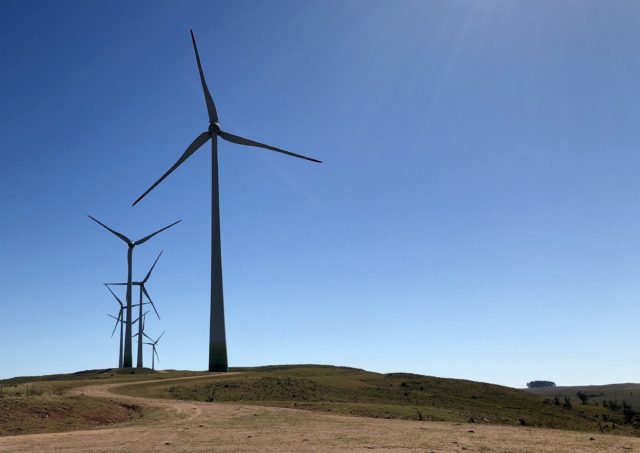
    We are pleased to announce that our client ENERCON together with eab New Energy GmbH have entered into a Share Purchase Agreement with leading Dutch infrastructure investor DIF, through its Infrastructure Fund V, for the sale of 100% of their share interest in Ladaner S.A., owner of the 50MW Cerro Grande wind farm in Uruguay.

    The project, comprising 22 turbines, has been operational since January 2018 and benefits from a 20-year power purchase agreement with UTE, Uruguay’s state-owned utility. The project will continue to be operated and maintained by ENERCON and asset management services continue to be delivered by SEG Heliotec.

    FICUS CAPITAL acted as exclusive M&A sell-side advisor to ENERCON.

    Closing of the transaction is subject to receipt of usual consents from project counterparties and is expected to take place in the course of 2019.

    About Ficus Capital

    FICUS CAPITAL is an investment banking firm and renewable energy structuring and development company, with strong presence in renewables through own investments and advising clients on their transactions globally, in countries such as Argentina, Uruguay, Brazil, Colombia, Mexico and Asia.

    As a member of the international Globalscope network, FICUS CAPITAL supports its clients in cross-border transactions via its fellow members country-specific expertise and networks. Mathias Möhrpahl, Director in Ficus Capital and who lead the transaction on behalf of Ficus Capital was recently named Sector Head of Renewable Energy at Globalscope.

    [/fusion_text][/fusion_builder_column][/fusion_builder_row][/fusion_builder_container]
  • Argentina, Chile y Brasil, los países más atractivos de LatAm para invertir en Renovables

    Argentina, Chile y Brasil, los países más atractivos de LatAm para invertir en Renovables

    [fusion_builder_container hundred_percent=”no” equal_height_columns=”no” menu_anchor=”” hide_on_mobile=”small-visibility,medium-visibility,large-visibility” class=”” id=”” background_color=”” background_image=”” background_position=”center center” background_repeat=”no-repeat” fade=”no” background_parallax=”none” parallax_speed=”0.3″ video_mp4=”” video_webm=”” video_ogv=”” video_url=”” video_aspect_ratio=”16:9″ video_loop=”yes” video_mute=”yes” overlay_color=”” video_preview_image=”” border_size=”” border_color=”” border_style=”solid” padding_top=”” padding_bottom=”” padding_left=”” padding_right=””][fusion_builder_row][fusion_builder_column type=”1_1″ layout=”1_1″ background_position=”left top” background_color=”” border_size=”” border_color=”” border_style=”solid” border_position=”all” spacing=”yes” background_image=”” background_repeat=”no-repeat” padding_top=”” padding_right=”” padding_bottom=”” padding_left=”” margin_top=”0px” margin_bottom=”0px” class=”” id=”” animation_type=”” animation_speed=”0.3″ animation_direction=”left” hide_on_mobile=”small-visibility,medium-visibility,large-visibility” center_content=”no” last=”no” min_height=”” hover_type=”none” link=””][fusion_text]

    El Índice de Atractivo de Energía Renovable por País que elabora cada año Ernst & Young incluye en esta ocasión solo a cinco países latinoamericanos. México y Perú empeoran su resultado frente a 2018.

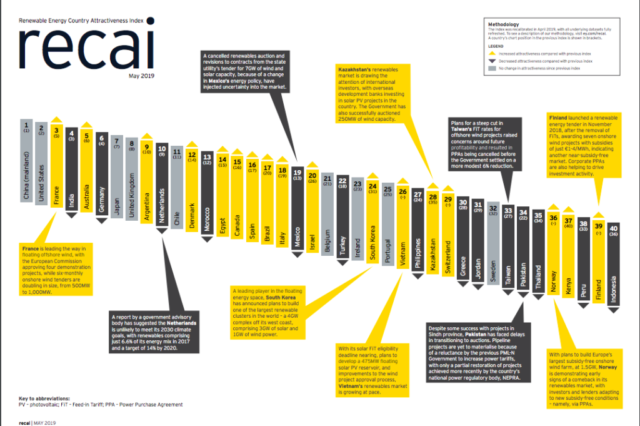
    Argentina, Chile y Brasil encabezan en América Latina el Índice de Atractivo de Energía Renovable por País (Renewable Energy Country Attractiveness Index, RECAI) que publica cada año la consultora de Reino Unido Ernst & Young (EY).

    El ranking clasifica a 40 países en cuanto al atractivo de su inversión en energía limpia. Para su calificación, la consultora analiza variables de tipo macroeconómico (estabilidad macroeconómica y facilidad para hacer negocios), mercado de energía (priorización sobre energía renovable y la facilidad de financiación de proyectos renovables) y tecnologías específicas (solar, eólica y otras tecnologías).

    En esta edición, incluye solo a cinco países latinoamericanos, de los que México y Perú presentan resultados bastante peores que en la edición de 2018:el primero ocupa el lugar 19.º frente al 13.º que ostentaba en 2018, y en 2017 fue el 9.º país de la lista.

    Según el índice, Argentina se mantiene dentro de los 10 mejores del mundo, al avanzar del 10.º al 9.º lugar respecto al ranking anterior. Muy de cerca le sigue Chile, que no registró variación y se mantuvo en el puesto 11.

    Brasil se mantuvo como el 3.º país de la región con más potencialidades para la energía renovable, y ocupa el puesto 17 en el ranking general. El resultado representa una mejora de tres puntos.

    México, por su parte, perdió 6 puntos al pasar de la posición 13 a la 19. Según el informe de EY, la cancelación de la subasta de renovables y la revisión de contratos llevada a cabo por el Gobierno han creado incertidumbre en el mercado.

    Perú en cambio, retrocedió cinco posiciones y pasó del puesto 33 al 38. El país no ha logrado alcanzar la meta inicial del 5% de participación de energías renovables no convencionales en la matriz energética.

    Un año más, encabezan el ranking RECAI China y EE. UU.. En cambio, Alemania desciende posiciones y es adelantada por Francia, seguida de la India y Australia. Los siguientes países son Alemania, Japón, Inglaterra, Argentina y Holanda. Los últimos lugares del ranking de 40 países lo ocupan Tailandia, Noruega, Kenia, Perú, Finlandia e Indonesia.

    Noticia de PV magazine: https://www.pv-magazine-latam.com/2019/07/05/argentina-chile-y-brasil-los-paises-mas-atractivos-de-latam-para-invertir-en-renovables/

    [/fusion_text][/fusion_builder_column][/fusion_builder_row][/fusion_builder_container]

  • Ficus Capital adquiere proyecto fotovoltaico “SOL DE BERMEJO”

    Ficus Capital adquiere proyecto fotovoltaico “SOL DE BERMEJO”

    [fusion_builder_container hundred_percent=”no” equal_height_columns=”no” menu_anchor=”” hide_on_mobile=”small-visibility,medium-visibility,large-visibility” class=”” id=”” background_color=”” background_image=”” background_position=”center center” background_repeat=”no-repeat” fade=”no” background_parallax=”none” parallax_speed=”0.3″ video_mp4=”” video_webm=”” video_ogv=”” video_url=”” video_aspect_ratio=”16:9″ video_loop=”yes” video_mute=”yes” overlay_color=”” video_preview_image=”” border_size=”” border_color=”” border_style=”solid” padding_top=”” padding_bottom=”” padding_left=”” padding_right=””][fusion_builder_row][fusion_builder_column type=”1_1″ layout=”1_1″ background_position=”left top” background_color=”” border_size=”” border_color=”” border_style=”solid” border_position=”all” spacing=”yes” background_image=”” background_repeat=”no-repeat” padding_top=”” padding_right=”” padding_bottom=”” padding_left=”” margin_top=”0px” margin_bottom=”0px” class=”” id=”” animation_type=”” animation_speed=”0.3″ animation_direction=”left” hide_on_mobile=”small-visibility,medium-visibility,large-visibility” center_content=”no” last=”no” min_height=”” hover_type=”none” link=””][fusion_text]

    Ficus Capital ha adquirido el proyecto fotovoltaico “Sol de Bermejo” de las firmas SEG Ingeniería y EAB New Energy GmbH. Este proyecto se construirá en la Provincia de La Rioja en Argentina, y complementa su portafolio de proyectos eólicos en el país.

    El proyecto Sol de Bermejo resultó Asignado con Prioridad de Despacho por CAMMESA en la ronda MaTER del 3er Trimestre del 2018, en marco de la resolución MEyM N° 281/17, con una potencia asignada de 18 MW y será conectado a la red eléctrica a través de la ET Villa Unión. Su entrada en operación comercial está proyectada para el verano del 2020.

    El Presidente de Ficus Capital, Paul Elberse, dijo que “con la compra de Sol de Bermejo se logra un hito importante para Ficus, ya que se trata de la adquisición del primer proyecto solar de la compañía en la Argentina, y ocurre cuando la energía solar está en su mejor momento para el desarrollo y explotación. Sol de Bermejo es un proyecto ideal para que los Grandes Usuarios de energía en el país se comprometan a adquirir la energía de fuentes renovables y así cumplan con sus objetivos en el marco de sus roles como Actores Responsables”

    Ficus Capital está totalmente comprometido con Argentina y su política de ampliación de la participación de Energías Renovables en su matriz energética. Siendo este uno de los países con los mejores recursos naturales del mundo, sumado al gran nivel de recursos humanos que trabajan en el desarrollo de proyectos de alto valor agregado, convierten a la Argentina en uno de los mercados con mayor potencial en los próximos años.

    Ficus continuará trabajando de la mano con SEG Ingeniería para llevar adelante el proyecto Sol de Bermejo, con la finalidad de ver materializado el emprendimiento para la fecha comprometida de COD.

    [/fusion_text][/fusion_builder_column][/fusion_builder_row][/fusion_builder_container]

  • Vietnam impulsa desarrollo de las energías renovables

    Vietnam impulsa desarrollo de las energías renovables

    [fusion_builder_container hundred_percent=”no” equal_height_columns=”no” menu_anchor=”” hide_on_mobile=”small-visibility,medium-visibility,large-visibility” class=”” id=”” background_color=”” background_image=”” background_position=”center center” background_repeat=”no-repeat” fade=”no” background_parallax=”none” parallax_speed=”0.3″ video_mp4=”” video_webm=”” video_ogv=”” video_url=”” video_aspect_ratio=”16:9″ video_loop=”yes” video_mute=”yes” overlay_color=”” video_preview_image=”” border_size=”” border_color=”” border_style=”solid” padding_top=”” padding_bottom=”” padding_left=”” padding_right=””][fusion_builder_row][fusion_builder_column type=”1_1″ layout=”1_1″ background_position=”left top” background_color=”” border_size=”” border_color=”” border_style=”solid” border_position=”all” spacing=”yes” background_image=”” background_repeat=”no-repeat” padding_top=”” padding_right=”” padding_bottom=”” padding_left=”” margin_top=”0px” margin_bottom=”0px” class=”” id=”” animation_type=”” animation_speed=”0.3″ animation_direction=”left” hide_on_mobile=”small-visibility,medium-visibility,large-visibility” center_content=”no” last=”no” min_height=”” hover_type=”none” link=””][fusion_text]

    Según un informe de la Organización de Desarrollo de Alemania, el potencial de la eólica de Vietnam se estima en 215 gigavatios.

    En los últimos años, Vietnam ha implementado una serie de medidas para promover el desarrollo de la energía renovable, conociendo que esas fuentes naturales no sólo garantizan el suministro de energía sino que contribuyen también al mejoramiento de la seguridad energética nacional.

    Desde 2017 el Gobierno de Vietnam eliminó los impuestos de importación sobre los productos destinados a la producción de energía solar y, al mismo tiempo, obligó a la corporación eléctrica nacional a comprar toda la electricidad generada por esos proyectos.

    Después de que el gobierno subió el precio de la electricidad en junio de 2017, se registraron cada mes nueve nuevos proyectos de producción y distribución de energía renovable, lo que demuestra el creciente interés que conceden los inversores a este sector de Vietnam, que prevé desarrollar con un ritmo de 23 por ciento durante el período 2020 a 2030.

    La nación indochina registra hasta hoy 245 proyectos de energía renovable que están en diferentes etapas de despliegue. Una vez entrados en operación todos, generarán 23,2 gigavatio de electricidad limpia, cifra que supera por 10 veces la meta fijada por Vietnam para 2020.

    Según un informe de la Organización de Desarrollo de Alemania, el potencial eólico de Vietnam se estima en 215 mil megavatios, y el solar en 340 mil megavatios. -VNA

    [/fusion_text][/fusion_builder_column][/fusion_builder_row][/fusion_builder_container]
  • Latin America and the Caribbean in 2018: An economic recovery in the making

    Latin America and the Caribbean in 2018: An economic recovery in the making

    [fusion_builder_container hundred_percent=”no” equal_height_columns=”no” menu_anchor=”” hide_on_mobile=”small-visibility,medium-visibility,large-visibility” class=”” id=”” background_color=”” background_image=”” background_position=”center center” background_repeat=”no-repeat” fade=”no” background_parallax=”none” parallax_speed=”0.3″ video_mp4=”” video_webm=”” video_ogv=”” video_url=”” video_aspect_ratio=”16:9″ video_loop=”yes” video_mute=”yes” overlay_color=”” video_preview_image=”” border_size=”” border_color=”” border_style=”solid” padding_top=”” padding_bottom=”” padding_left=”” padding_right=”” admin_toggled=”no”][fusion_builder_row][fusion_builder_column type=”1_1″ layout=”1_1″ background_position=”left top” background_color=”” border_size=”” border_color=”” border_style=”solid” border_position=”all” spacing=”yes” background_image=”” background_repeat=”no-repeat” padding_top=”” padding_right=”” padding_bottom=”” padding_left=”” margin_top=”0px” margin_bottom=”0px” class=”” id=”” animation_type=”” animation_speed=”0.3″ animation_direction=”left” hide_on_mobile=”small-visibility,medium-visibility,large-visibility” center_content=”no” last=”no” min_height=”” hover_type=”none” link=””][fusion_text]

    Recent trends in the world economy and financial markets are good news for Latin America. Global growth and trade are on an upswing, and we expect the momentum to continue in 2018. Stronger commodity prices have also helped the region rebound.

    Benefiting from these better global conditions, Latin America’s economic recovery is gaining momentum too, as recessions in a few countries come to an end (Brazil, Argentina, and Ecuador). We now estimate regional growth at 1.3 percent in 2017 (up from 1.2 percent in our October projections), and we project activity to accelerate further to 1.9 percent in 2018 and 2.6 percent in 2019.

    [/fusion_text][/fusion_builder_column][fusion_builder_column type=”1_1″ layout=”1_1″ spacing=”” center_content=”no” link=”” target=”_self” min_height=”” hide_on_mobile=”small-visibility,medium-visibility,large-visibility” class=”” id=”” background_color=”” background_image=”” background_position=”left top” background_repeat=”no-repeat” hover_type=”none” border_size=”0″ border_color=”” border_style=”solid” border_position=”all” padding_top=”” padding_right=”” padding_bottom=”” padding_left=”” dimension_margin=”” animation_type=”” animation_direction=”left” animation_speed=”0.3″ animation_offset=”” last=”no”][fusion_imageframe image_id=”12642″ style_type=”none” stylecolor=”” hover_type=”none” bordersize=”” bordercolor=”” borderradius=”” align=”center” lightbox=”no” gallery_id=”” lightbox_image=”” alt=”” link=”” linktarget=”_self” hide_on_mobile=”small-visibility,medium-visibility,large-visibility” class=”” id=”” animation_type=”” animation_direction=”left” animation_speed=”0.3″ animation_offset=””]http://www.ficuscapital.com/wp-content/uploads/2018/06/estadisticas.png[/fusion_imageframe][/fusion_builder_column][fusion_builder_column type=”1_1″ layout=”1_1″ spacing=”” center_content=”no” link=”” target=”_self” min_height=”” hide_on_mobile=”small-visibility,medium-visibility,large-visibility” class=”” id=”” background_color=”” background_image=”” background_position=”left top” background_repeat=”no-repeat” hover_type=”none” border_size=”0″ border_color=”” border_style=”solid” border_position=”all” animation_type=”” animation_direction=”left” animation_speed=”0.3″ animation_offset=”” last=”no”][fusion_text]

    Consumption and exports were the main growth drivers last year. Encouragingly, investment is no longer a drag and is expected to be an important factor behind the acceleration in output this year and next. Inflation came down significantly in 2017 in many countries, providing some scope for easing monetary policy.

    [/fusion_text][/fusion_builder_column][fusion_builder_column type=”1_1″ layout=”1_1″ spacing=”” center_content=”no” link=”” target=”_self” min_height=”” hide_on_mobile=”small-visibility,medium-visibility,large-visibility” class=”” id=”” background_color=”” background_image=”” background_position=”left top” background_repeat=”no-repeat” hover_type=”none” border_size=”0″ border_color=”” border_style=”solid” border_position=”all” animation_type=”” animation_direction=”left” animation_speed=”0.3″ animation_offset=”” last=”no”][fusion_imageframe image_id=”12645″ style_type=”none” stylecolor=”” hover_type=”none” bordersize=”” bordercolor=”” borderradius=”” align=”center” lightbox=”no” gallery_id=”” lightbox_image=”” alt=”” link=”” linktarget=”_self” hide_on_mobile=”small-visibility,medium-visibility,large-visibility” class=”” id=”” animation_type=”” animation_direction=”left” animation_speed=”0.3″ animation_offset=””]http://www.ficuscapital.com/wp-content/uploads/2018/06/estadisticas2.png[/fusion_imageframe][/fusion_builder_column][fusion_builder_column type=”1_1″ layout=”1_1″ spacing=”” center_content=”no” link=”” target=”_self” min_height=”” hide_on_mobile=”small-visibility,medium-visibility,large-visibility” class=”” id=”” background_color=”” background_image=”” background_position=”left top” background_repeat=”no-repeat” hover_type=”none” border_size=”0″ border_color=”” border_style=”solid” border_position=”all” animation_type=”” animation_direction=”left” animation_speed=”0.3″ animation_offset=”” last=”no”][fusion_text]

    The recovery is broad based across the region. While Mexico, Central America, and parts of the Caribbean are benefiting from stronger growth in the United States, growth in South America is mainly driven by the end of recessions in Brazil, Argentina, and Ecuador as well as higher commodity prices.

    [/fusion_text][/fusion_builder_column][fusion_builder_column type=”1_1″ layout=”1_1″ spacing=”” center_content=”no” link=”” target=”_self” min_height=”” hide_on_mobile=”small-visibility,medium-visibility,large-visibility” class=”” id=”” background_color=”” background_image=”” background_position=”left top” background_repeat=”no-repeat” hover_type=”none” border_size=”0″ border_color=”” border_style=”solid” border_position=”all” animation_type=”” animation_direction=”left” animation_speed=”0.3″ animation_offset=”” last=”no”][fusion_imageframe image_id=”12649″ style_type=”none” stylecolor=”” hover_type=”none” bordersize=”” bordercolor=”” borderradius=”” align=”center” lightbox=”no” gallery_id=”” lightbox_image=”” alt=”” link=”” linktarget=”_self” hide_on_mobile=”small-visibility,medium-visibility,large-visibility” class=”” id=”” animation_type=”” animation_direction=”left” animation_speed=”0.3″ animation_offset=””]http://www.ficuscapital.com/wp-content/uploads/2018/06/estadisticas3.jpg[/fusion_imageframe][/fusion_builder_column][fusion_builder_column type=”1_1″ layout=”1_2″ spacing=”” center_content=”no” link=”” target=”_self” min_height=”” hide_on_mobile=”small-visibility,medium-visibility,large-visibility” class=”” id=”” background_color=”” background_image=”” background_position=”left top” background_repeat=”no-repeat” hover_type=”none” border_size=”0″ border_color=”” border_style=”solid” border_position=”all” padding_top=”” padding_right=”” padding_bottom=”” padding_left=”” dimension_margin=”” animation_type=”” animation_direction=”left” animation_speed=”0.3″ animation_offset=”” last=”no”][fusion_text]

    North America

    In the United States, reforms to U.S. corporate and personal income taxes passed in December 2017 will likely raise private investment and private consumption over the short term, lifting growth to 2.7 percent for 2018 and 2.5 percent for 2019, from the estimated 2.3 percent in 2017.

    This has led to an improvement in Canada’s growth prospects for 2018–19, with the growth estimate for 2017 unchanged at 3 percent. Even with the boost from the United States, growth is expected to slow to 2.3 percent in 2018 and 2 percent in 2019, as higher interest rates and tighter macroprudential policies to mitigate financial risks from housing and mortgage markets continue to take effect.

    Mexico’s outlook is projected to benefit from higher growth in the United States, although uncertainty about the outcome of the North American Free Trade Agreement renegotiation and Mexico’s July presidential election will weigh on growth in the near term. To this end, output growth is projected to accelerate from an estimated 2 percent in 2017 to 2.3 percent in 2018. Inflation is expected to fall sharply in 2018 as the effect of last year’s increase in administered domestic fuel prices fades. Continuation of prudent fiscal policy aimed at a reduction of the public debt ratio is key to maintain macroeconomic and financial stability.

    Central America and the Caribbean

    In Central America and the Dominican Republic, output growth remains robust, helped by stronger than anticipated remittances flows, improved financial conditions, and good harvests.

    Economic prospects for the Caribbean are generally improving. Modest growth is expected in the region in both 2018 and 2019, supported by higher U.S. growth following the recent U.S. tax reform. However, some of the islands that were hit hard during the 2017 hurricane season face a protracted recovery. In Dominica, GDP is projected to decline by 16 percent in 2018, before rebounding in 2019 as reconstruction gathers pace.

    South America

    In Argentina, economic activity in 2017 is projected to be 2.8 percent, up from 2.4 percent in the October 2017 WEO. While consumption benefited from rising real wages, investment also accelerated including in the private sector. Growth is expected to weaken slightly to 2½ percent in 2018, owing to fiscal and monetary restraint. Inflation is expected to continue to fall, assuming wage moderation. The reduction of the primary fiscal deficit should help contain appreciation pressures on the peso and the deterioration of the current account.

    In Brazil, after a severe recession in 2015 and 2016, the economic recovery is gaining strength, spurred by private consumption and investment. Inflation in 2017 fell to 3 percent, driven by a sharp decline in food prices due to an exceptional harvest. Our forecast for Brazil’s growth in 2018 has been revised up significantly relative to the October 2017 WEO. However, the uncertain outcome of the 2018 general elections may weigh down economic growth. To ensure fiscal sustainability, the Brazilian authorities plan to undertake a prolonged fiscal consolidation, which includes an ambitious reform of social security.

    In Chile, after a slow start in 2017, growth picked up in the second half of the year, and the momentum is expected to carry over into 2018, where growth is projected at 3 percent. Higher copper prices and improving business sentiment—especially after the resolution of political uncertainty related to the 2017 presidential elections—have been supporting growth.

    In Colombia, growth has picked up gradually as the negative effects of the large fall in oil prices of 2014–16 fade. Falling inflation has made room for growth-supporting monetary easing. Against a background of improving global growth and rising oil prices, the outlook is for a strengthening of the recovery and continued convergence of inflation to the target. Medium-term growth prospects are favorable, helped by export growth and infrastructure investment.

    Ecuador’s economy had a speedier-than-anticipated recovery in 2017, with growth estimated at 2.7 percent. The recovery was supported by the partial recovery in oil prices and increased access to international financial markets. The new administration is making efforts to engage with the private sector and tackle corruption, which could benefit the economy in the longer term. However, in the short term, the economy remains vulnerable to external shocks, calling for reducing the fiscal deficit and regaining competitiveness through structural reforms.

    In Peru, growth showed signs of recovery in the second half of 2017. In 2018, a broad-based expansion in domestic demand is expected to drive growth up to around 4 percent. Exports should remain robust, but their contribution would be more modest than in the last two years given that new mining projects reached nearly production capacity in 2017. On the policy side, the authorities remain focused on implementing countercyclical fiscal and monetary policy and structural reforms. The planned fiscal impulse in 2018 will be key to achieving a growth rebound.

    In Venezuela, the crisis continues. Real GDP is projected to fall by about 15 percent in 2018—a cumulative GDP decline of almost 50 percent since 2013. This trend is the result of significant micro-level distortions and macroeconomic imbalances compounded by the collapse in oil exports—initially from the sharp fall in oil prices in mid-2014 and, more recently, from the collapse in domestic oil production. Inflation is projected to have exceeded 2,400 percent in 2017 and to rise to about 13,000 percent in 2018, fueled by monetary financing of large fiscal deficits and the loss of confidence in the nation’s currency.

    Risks to the economic recovery

    Several risks could hurt the region’s recovery. Upcoming elections in many countries creates economic and policy uncertainties in the next year. Pressures for inward-looking policies in advanced economies—including through a retreat from cross-border integration—and factors such as global geopolitical tensions and extreme weather events could compound these uncertainties.

    In addition, financial market conditions could tighten if inflation increases more than expected in the United States or if global financial vulnerabilities build up due to excessive risk taking during the long-lasting period of very low interest rates and low asset price volatility.

    Good time to rebuild buffers and raise medium-term growth

    Looking beyond the near term, the region faces serious medium-term challenges. As we have been emphasizing, despite the current economic acceleration, Latin America’s output growth is returning to an underwhelming mean. Subdued potential growth and downside medium-term risks call for further efforts to rebuild buffers and implement structural policies to address growth bottlenecks and improve resilience.

    In countries where fiscal deficits need to be lowered, attention should be given to the fine balance between.

    [/fusion_text][/fusion_builder_column][/fusion_builder_row][/fusion_builder_container]
  • Argentina to invest in sustainable energy with IDB support

    Argentina to invest in sustainable energy with IDB support

    [fusion_builder_container hundred_percent=”no” hundred_percent_height=”no” hundred_percent_height_scroll=”no” hundred_percent_height_center_content=”yes” equal_height_columns=”no” menu_anchor=”” hide_on_mobile=”small-visibility,medium-visibility,large-visibility” class=”” id=”” background_color=”” background_image=”” background_position=”center center” background_repeat=”no-repeat” fade=”no” background_parallax=”none” enable_mobile=”no” parallax_speed=”0.3″ video_mp4=”” video_webm=”” video_ogv=”” video_url=”” video_aspect_ratio=”16:9″ video_loop=”yes” video_mute=”yes” video_preview_image=”” border_size=”” border_color=”” border_style=”solid” margin_top=”” margin_bottom=”” padding_top=”” padding_right=”” padding_bottom=”” padding_left=””][fusion_builder_row][fusion_builder_column type=”1_1″ layout=”1_1″ spacing=”” center_content=”no” link=”” target=”_self” min_height=”” hide_on_mobile=”small-visibility,medium-visibility,large-visibility” class=”” id=”” background_color=”” background_image=”” background_position=”left top” background_repeat=”no-repeat” hover_type=”none” border_size=”0″ border_color=”” border_style=”solid” border_position=”all” padding_top=”” padding_right=”” padding_bottom=”” padding_left=”” dimension_margin=”” animation_type=”” animation_direction=”left” animation_speed=”0.3″ animation_offset=”” last=”no”][fusion_text]

    Loan of $100 million from the Green Climate Fund will benefit Small and Medium Enterprises investing in renewable energy and energy efficiency projects

    Argentina will increase Small and Medium Enterprises (SME) investments in renewable energy and energy efficiency by providing greater access to finance, with a $100 million loan approved by the Inter-American Development Bank.

    The loan will specifically finance small-sized renewable energy generation projects (mainly biogas and biomass) and efficiency improvements in industrial processes, including equipment replacement and cogeneration.

    Improved efficiency in the use and production of energy will help cut greenhouse gas emissions and enable energy consumers to benefit from greater and better availability of cleaner energy at competitive prices.

    The operation is expected to have an important transformational impact by helping SMEs access more financing and allow them to scale up their investments. SMEs in Argentina face multiple obstacles that prevent them from investing in renewable energy and energy efficiency, with inadequate access to finance among the major impediments.

    These companies also face higher transaction costs than larger firms, and in many cases, lack appropriate collateral to comply with banking requirements. In Argentina, credit to microenterprises and SMEs represents only 3 percent of GDP, although these firms account for at least 50 percent of GDP and generate around 71 percent of total employment.

    In addition to this program, the IDB is supporting Argentina with $3.6 million in technical cooperation grants geared at promoting energy efficiency investments by small and medium enterprises which, among others, will replicate the IDB’s Energy Savings Insurance strategy, which was endorsed by the Global Innovation Lab for Climate Finance as one of the most promising instruments to mobilize private sector investments in energy efficiency.

    The project will be executed by the Banco de Inversión y Comercio Exterior (BICE), a public bank that grants medium- and long-term credit aimed at productive investment and foreign trade.

    The IDB financing is for a 20-year term, with a 5.5-year grace period and a 0.75 fixed interest rate.

    About the IDB

    The Inter-American Development Bank is devoted to improving lives. Established in 1959, the IDB is a leading source of long-term financing for economic, social and institutional development in Latin America and the Caribbean. The IDB also conducts cutting-edge research and provides policy advice, technical assistance and training to public and private sector clients throughout the region.

    [/fusion_text][/fusion_builder_column][/fusion_builder_row][/fusion_builder_container]